Research Directions, Uday Khankhoje
Our work in the NEMO group sits at the intersection of electromagnetics, applied mathematics, and machine learning. The three broad directions we are busy with these days are described below. A good bit of the code we write along the way is open-sourced on our Code page – so do have a look if something here catches your fancy.
6G RF research
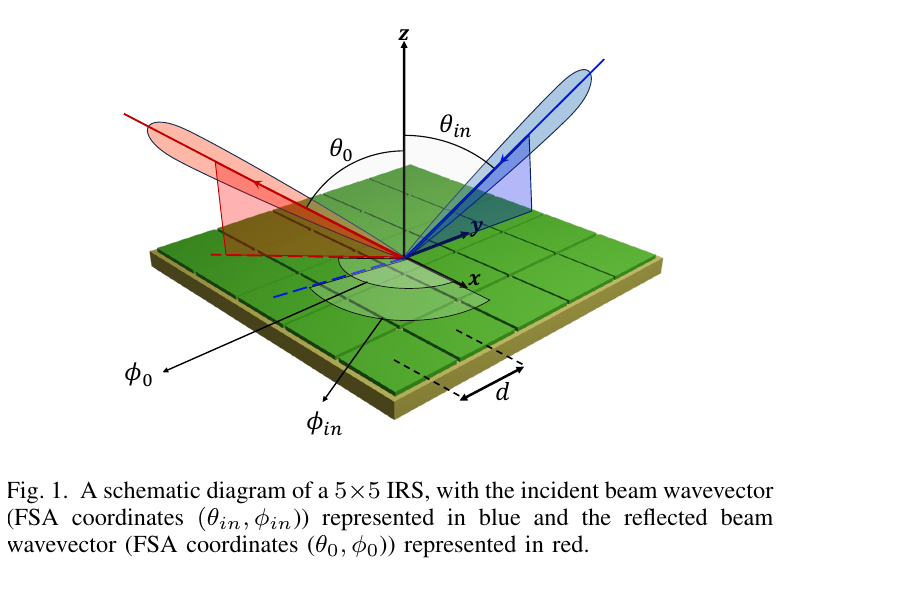 |
Upcoming cellular generations such as 6G will operate at higher carrier frequencies to deliver the datarates we increasingly demand. But as frequencies climb, electromagnetic waves diffract less around obstacles, and coverage in complex multipath environments drops. Intelligent reflecting surfaces (IRS, also called RIS) are engineered surfaces of sub-wavelength elements that can be reconfigured on the fly to bounce incoming waves toward users – restoring coverage that would otherwise be lost, and doing so as a passive, low-power device. A central challenge is that real hardware can only realise a discrete set of phase shifts at each element, which turns beamforming into a hard discrete-optimization problem. We have developed provably-optimal, linear-time algorithms for this problem, together with strategies to suppress the spurious “grating lobes” that 1-bit surfaces produce. The full implementation is open-source. We are also studying the implications of the reciprocity theorem for RIS, and the use of orbital angular momentum (OAM) modes to multiplex several data streams in parallel over a single link. |
This direction is supported by the MeitY "6G: Sub-THz Wireless Communication with Intelligent Reflecting Surfaces" grant and the Qualcomm 6G University Research India Program. There is a fair bit to chew on here for anyone who enjoys electromagnetics, optimization, and wireless systems together – if that sounds like you, do write to me.
Inverse Design
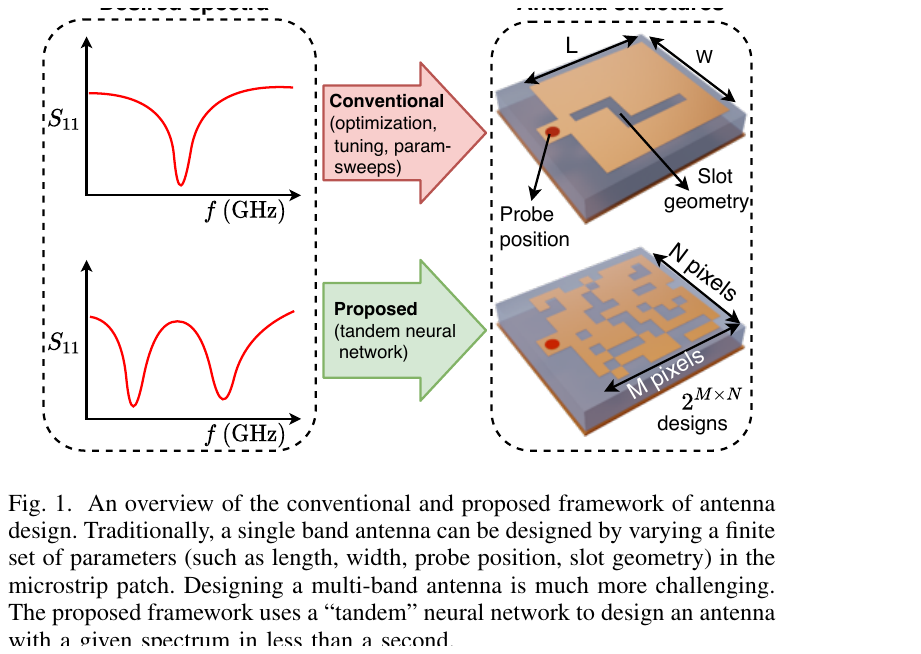 |
Inverse design reverses the usual engineering workflow: instead of laboriously tuning a device and re-simulating it repeatedly, one specifies the desired performance and lets an algorithm arrive at the design. For e.g. one may ask for an antenna resonant at two prescribed frequency bands, and obtain a physical layout in under a second. To make this possible, we use numerical optimization and deep learning in conjunction with full-wave electromagnetic solvers. Our tandem neural networks design compact, multi-band “pixelated” antennas that are smaller than conventional designs. Related work with collaborators at Princeton extends these ideas to the generalized inverse design of RF and sub-terahertz integrated circuits (published in Nature Communications), while transfer learning allows a trained network to rapidly adapt to new substrates and frequency bands. The trained models and the associated design code are available on our Code page. |
Inverse Imaging
 |
In problems such as breast-cancer screening, cancerous tissue has different electrical properties (e.g. dielectric permittivity) than healthy tissue at microwave frequencies. So, if we can acquire an image of the permittivity of the tissue, we may be able to flag the disease – non-invasively, at low cost, and without ionising radiation. The setup (left) surrounds the object of interest with transmitters and receivers and measures the scattered fields. We then solve a mathematical problem that takes these fields back to the permittivity as a function of space. Now this problem is rather badly behaved – severely ill-posed and non-linear – so apart from electromagnetic solvers we borrow ideas from linear algebra, image processing, compressive sensing, and machine learning. The same framework carries over nicely to other problems, such as buried-object detection, through-the-wall imaging, and the prediction of fields in cluttered environments. |
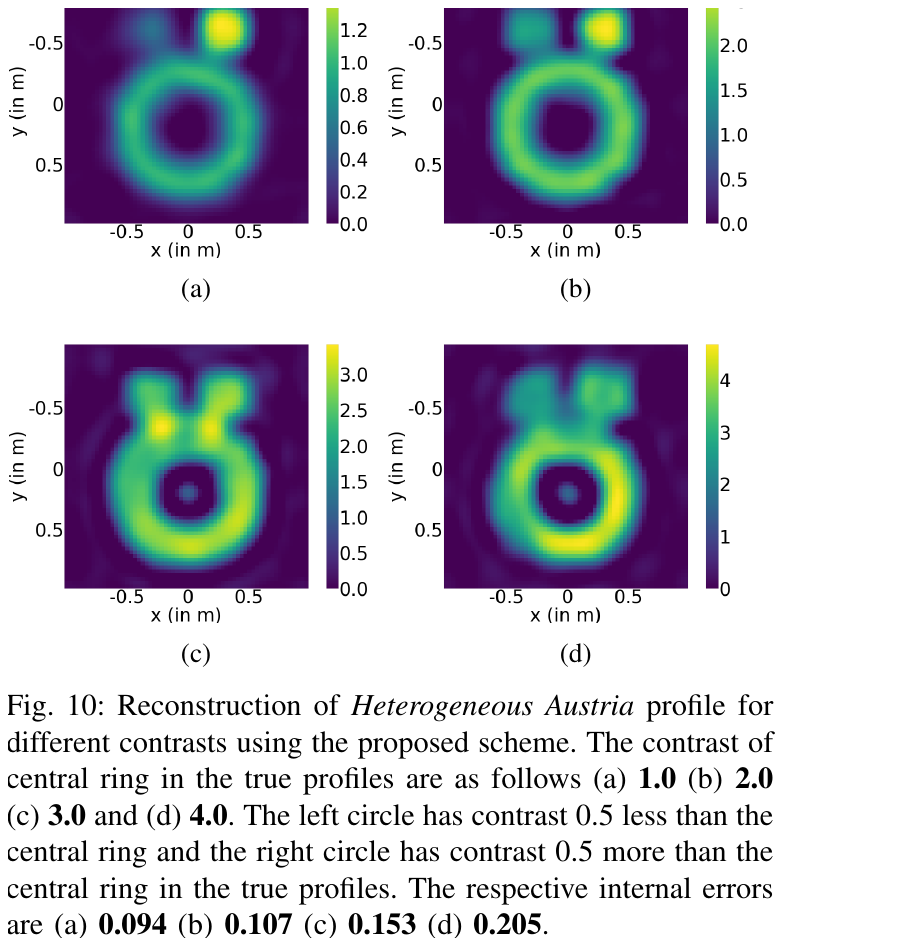 |
A representative result is shown alongside: reconstructed permittivity maps of the standard “Austria” benchmark at increasing contrast, obtained by embedding a deep network within a physics-based iterative solver. The nice part is that this keeps the rigour of the underlying physics intact, while letting the network supply a learned prior; the code is up on our Code page if you would like to try it for yourself. Work from this group has been featured in The Hindu and The Indian Express. |