Description
Camera networks deployed for persistent surveillance and monitoring generate enormous volumes of video data, creating serious challenges for storage, communication bandwidth and downstream computation. Compressive cameras, which acquire a small number of coded, multiplexed measurements rather than a full-resolution frame at every sensor, offer an attractive way to curb this data deluge at the point of capture.
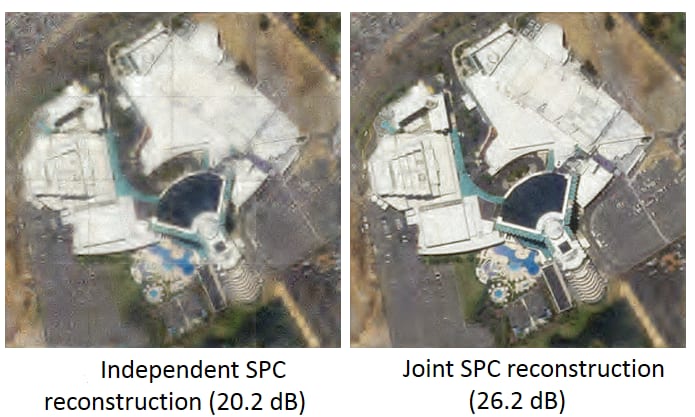
In this article we discuss the promise and the practical challenges of building compressive camera networks. We look at how compressive measurements from individual cameras can be exploited jointly across a network, taking advantage of correlations between overlapping fields of view, to improve reconstruction quality and to enable network-level tasks such as tracking and recognition directly from compressive measurements.
We also survey the open problems that stand between today's single-camera compressive imaging prototypes and a fully compressive camera network: designing multiplexing patterns that are well matched to network-level inference tasks, developing reconstruction algorithms that scale to many cameras, and building hardware that is compact and power-efficient enough for wide deployment.