Description
Transient imaging, or light-in-flight imaging, captures the propagation of an ultra-short pulse of light through a scene, effectively recording the optical impulse response of the scene. Recent work has shown that transient images can be captured using commercially available correlation-based Time-of-Flight (ToF) sensors, but the temporal resolution of these captures is fundamentally limited by the speed of the high-frequency electronics used to modulate the light source and sensor.
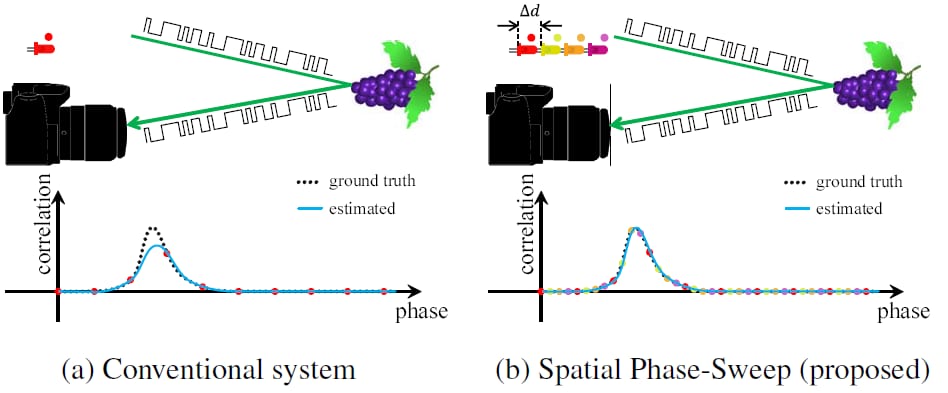
We propose Spatial Phase-Sweep (SPS), a technique that gets around this electronic bottleneck by exploiting the finite speed of light itself. Instead of relying on the modulation electronics to introduce finer phase shifts, SPS employs a linear array of light sources placed with a small, controlled spatial separation between them. Because light takes a slightly different amount of time to travel from each source to the scene, the differential positioning introduces sub-nanosecond time shifts in the arriving wavefront.
Using the same off-the-shelf electronics as a conventional ToF-based transient imaging system, this spatial trick lets us sample the transient response of a scene far more densely in time, pushing the achievable temporal resolution well beyond the 100-picosecond limit imposed by current electronics. We build a prototype spatial phase-sweep system and demonstrate transient imaging results that confirm the improved temporal sampling.