Description
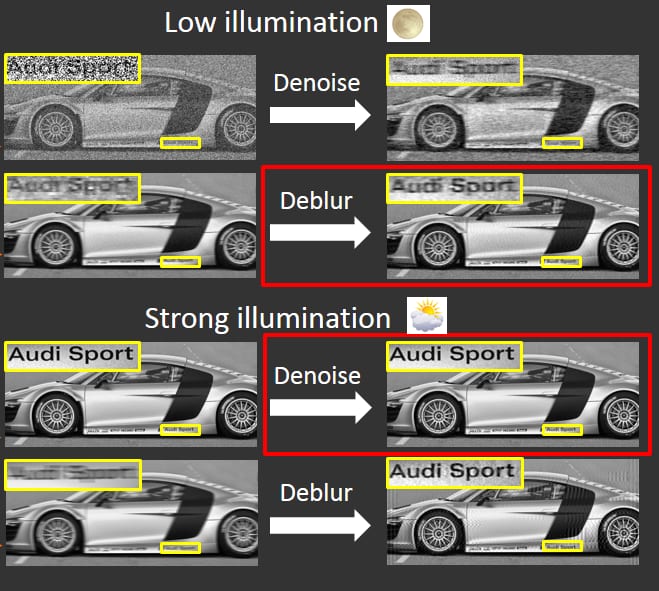
Smartphone cameras have improved considerably over the years, but their small sensors still produce noisy images in low light. One way to improve image quality is to increase the aperture size or exposure time so that more light reaches the sensor, but doing so makes the capture more susceptible to defocus blur or motion blur, which must then be corrected computationally.
This raises a natural design question: given a fixed illumination level, is it better to keep the aperture and exposure time small and simply denoise the resulting noisy image, or to open up the aperture and exposure and instead deblur the resulting sharper-but-blurred image? We study this denoise-versus-deblur trade-off quantitatively using a previously developed framework for analyzing computational imaging systems that jointly accounts for optical multiplexing, sensor noise characteristics, and the image prior used during reconstruction.
Our analysis provides a principled way to choose imaging system parameters, such as aperture size and exposure time, as a function of the illumination level, so that the eventual reconstruction error is minimized. We show that the optimal choice depends strongly on the light level, and that neither pure denoising nor pure deblurring is uniformly best across the full range of imaging conditions.